Reservoir Action Group
Saving Llanishen and Lisvane Reservoirs, Cardiff
History of the Reservoirs
A comprehensive account of the history of the reservoirs and the campaign by RAG to save them is now available in the form of a book. Further details can be accessed here.
A brief history is provided below:
Background
The Reservoir Action Group (RAG) is an organisation formed in 2001 to prevent a housing development on Llanishen Reservoir in north Cardiff (see map below) and to maintain public access to both Llanishen and Lisvane reservoirs.
These reservoirs form the southern end of the historic Brecon to Cardiff water supply system which brought clean water into the city over 100 years ago. The background to their construction can be read here: The Corporation Waterworks Undertaking. Both reservoirs were declared redundant for water supply purposes in the 1970s, but remain as a valuable resource for North Cardiff.
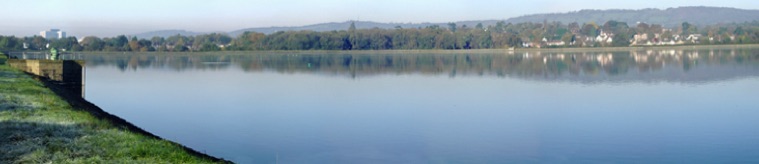
Until 2004, the two reservoirs were owned by Welsh Water. The public were permitted to walk round both via a permit scheme. On Llanishen reservoir there was an active Cardiff Council Sailing School and there was fly fishing for trout on both reservoirs. The reservoirs are within the Nant Fawr river corridor, one of the four protected green corridors into the city from the countryside, as defined in Cardiff Council's Local Development Plan.
Western Power Distribution (WPD)
In 2004 the reservoirs were acquired by Western Power Distribution (WPD), and the situation rapidly changed. Over the following years the Sailing School was run down, fly fishing was no longer permitted, and public access was ended with the site being fenced and gates locked. Prior to this WPD had submitted a planning application to partially drain Llanishen Reservoir and to build over 320 houses and apartments.
This was the start of a 10 year planning battle, with RAG in the forefront of the opposition to WPD’s plans. There was a Public Inquiry in 2006 into the application which subsequently refused planning consent. Further applications were submitted over the years by WPD for basically similar development proposals but with changes to design, layout and access. Two further Inquiries were held in 2008 and 2011, both of which refused consent. RAG was legally represented at these inquiries, and RAG members also gave evidence.
In 2009, largely through the efforts of RAG, the structure of Llanishen Reservoir was designated as a Listed Building, being of historic interest as part of the Taf Fawr water supply system for Cardiff. This was a critical issue in the refusal of WPD’s final planning application in 2013 due to the harm their scheme would have caused to the structure and particularly its setting. The other main reason for refusal was that of unacceptable vehicular access onto Lisvane Road.
Draining of Llanishen Reservoir
In 2010, WPD drained Llanishen Reservoir of its water, claiming that this was required for a safety inspection. However despite claims that it would be refilled refilled when this was completed, it was left empty. In 2012, WPD formally had Llanishen Reservoir abandoned as a reservoir under the Reservoirs Act 1975. This meant that before it could be refilled, a professional Reservoir Engineer must inspect the reservoir and declare the structure safe before supervising the refill.
Change of Ownership
In September 2013, WPD sold the reservoirs to Celsa, a Catalan company who took over the Allied Steel and Wire works in Cardiff Bay in 2003. Its interest in the site was because its steelworks in Cardiff Bay takes water from Lisvane reservoir and it wanted to secure the supply. However, its purchase of the site coincided with a difficult period for the steel industry and Celsa did not have the time or resources to re-develop the site itself.
Welsh Water Returns!
On 20th January 2016 it was announced that Celsa had granted a 999 year lease for the reservoir site to Dŵr Cymru / Welsh Water who announced that it hoped to refill Llanishen reservoir and allow public access to the area once more. Work began on the restoration of Llanishen reservoir in July 2016 and the initial work involved the clearing of vegetation that had grown up alongside the main dam. This was followed by repairs to some of the valve work as well as the complete drain down of Llanishen reservoir which had partially refilled due to a blocked scour valve. The drain down was completed in December 2017 and the vegetation which had grown up in the reservoir basin has been removed. Extensive repairs to the stone pitching, valve tower and other infrastructure have been made, and the reservoir refilled. Dŵr Cymru / Welsh Water constructed a network of paths, an education centre, conservation areas, a visitor centre and facilities for watersports. The reservoirs were reopened to the public on 28th July 2023.